
Guilt-Free Log-Off: Using Pomodoro Cycles to Signal the End of Your Remote Day

The biggest challenge of working from home is not distraction; it’s knowing when to stop. Without the commute or the physical office door, the line between personal time and professional duties vanishes. This constant blending of roles is the number one driver of remote work burnout, leading to lower productivity and chronic stress.
The solution isn't willpower; it’s structure. The Pomodoro Technique, specifically the consistent structure provided by the Pomodoro Desk timer, gives you the psychological and physical signal you need to achieve a Guilt-Free Log-Off. This article will guide remote workers and solopreneurs through three essential cycles designed to build the strongest boundary of all: the end of the workday.
📑 What You'll Learn
🧠 The Psychology of Detachment: Why It's So Hard
You aren't "addicted to work." You are suffering from the Zeigarnik Effect. This psychological phenomenon states that people remember uncompleted or interrupted tasks better than completed ones.
When you close your laptop with 15 open tabs and 3 half-written emails, your brain keeps those loops open. It continues to process them in the background, draining your energy while you try to watch Netflix or play with your kids.
The Solution: Cognitive Closure
You don't need to finish every task to stop the Zeigarnik Effect. You just need to plan when you will finish them. Writing down "Finish report tomorrow at 9 AM" signals to your brain that the task is "handled," allowing the loop to close.
1. The "Last Sprint": Protecting Your Final Focus Block (25 or 45 Minutes)
The last hour of your day should be the most productive, yet it’s often filled with administrative busywork and mental fatigue. This is where your Pomodoro Desk timer becomes an Anchor against overextension.
Defining the Final Work Cycle
Designate your final Pomodoro (25 or 45 minutes) as the Last Sprint. During this time, you should only tackle high-impact, high-priority tasks that provide momentum for the next morning. No email, no Slack, no planning for future projects. This cycle is your final commitment to deep work for the day.
By defining this final focus block, you tell your brain two things: 1) this is the most important work, and 2) its completion marks the beginning of the end. The Hard Stop rule must be applied here: when the timer dings, the work is finished, regardless of whether you completed the task.
2. The "Digital Desk Decompression" Cycle (10 Minutes)
The biggest mistake remote professionals make is closing the laptop and immediately trying to engage in family or social life. Your brain needs a transition period—a decompression cycle—to switch from problem-solving mode to passive mode.
Structuring the 10-Minute Transition
Immediately following your Last Sprint, start the 10-minute break button on your Pomodoro Desk timer. This time is non-negotiable and non-digital.
- Mandatory Shutdown: Use the first 60 seconds to fully shut down your work computer and clear your physical desk.
- Brain Dump: Spend the remaining time writing down the three most important tasks for the following morning. This offloads mental clutter, preventing those thoughts from interrupting your evening.
- Physical Movement: Finish the cycle with a mindfulness exercise or a simple stretch to signal the physical release of work tension.
This dedicated 10-minute transition cycle acts as a psychological "virtual commute." It is an intentional boundary that separates your billable time from your personal life, preventing the spillover effect of work stress.
✅ The Ultimate Shutdown Ritual Checklist
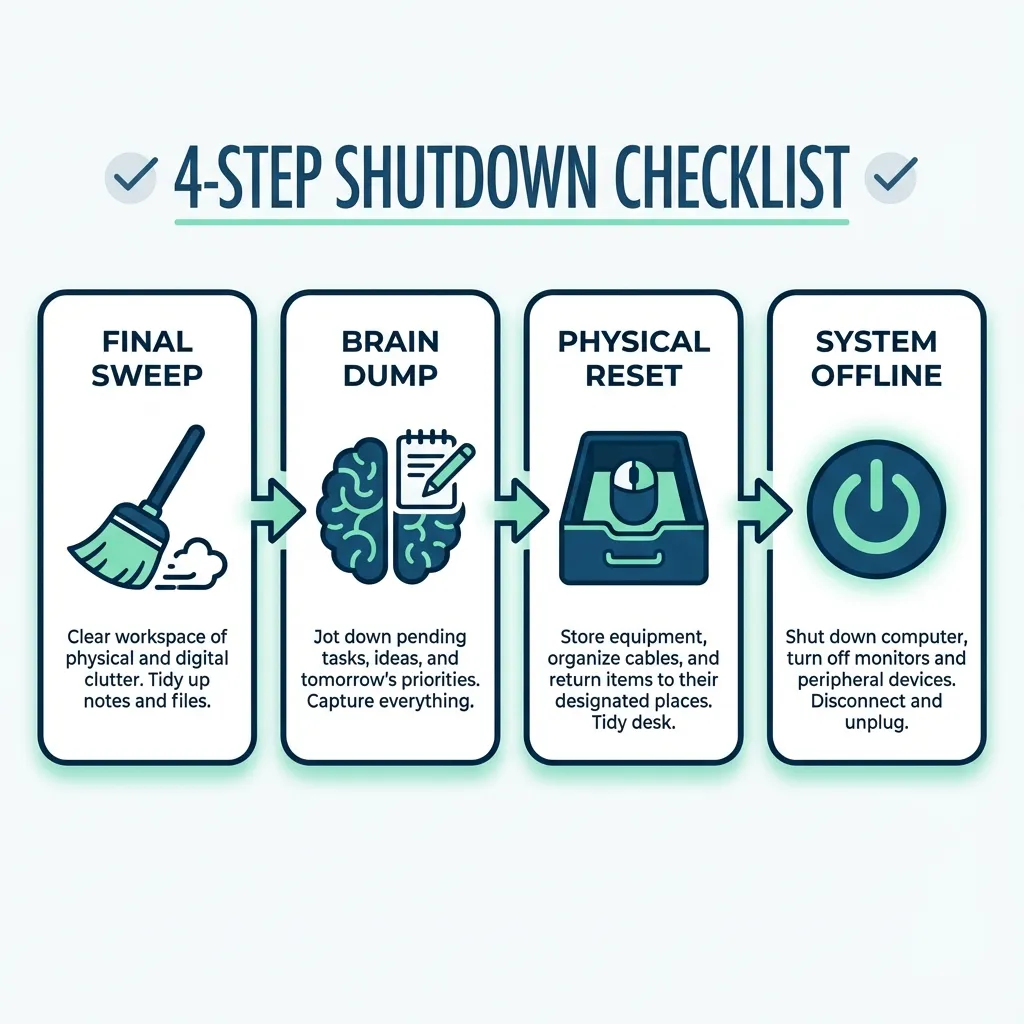
Do not just close your laptop. Follow this 4-step protocol during your 10-minute decompression cycle to officially close the shop.
1. The Final Sweep
Close all tabs. Inbox Zero (or snooze everything else). Clear the desktop.
2. The Brain Dump
Write down the 3 Big Tasks for tomorrow. Leave them on your physical desk.
3. The Physical Reset
Put your mouse in a drawer. Cover your monitor. Hide the evidence of work.
4. The Phrase
Say out loud: "System Offline." It sounds cheesy, but it works.
🛡️ Boundary Scripts: What to Say
The hardest part of logging off is the fear of disappointing someone. Here are copy-paste scripts to protect your time without being rude.
Scenario 1: The 5:05 PM Slack Message
Scenario 2: The "Urgent" Friday Email
Scenario 3: The "Just One Quick Call"
3. The "2-Minute Transition" for Personal Life Anchor
After your digital decompression, you need a quick anchor to ground you in your personal time. This ensures you don't gravitate back to your phone or laptop out of habit.
Creating a Personal Anchor Ritual
Use the 2-minute reset timer on your Pomodoro Desk for a simple, non-work ritual that begins your evening:
- Change Clothes: A quick, powerful signal to the brain that the work uniform is off.
- Evening Aroma: Light a specific candle or run hot water to create an environmental cue.
- Family Connection: Dedicate 2 minutes to connecting with a family member or pet without discussing work.
This intentional ritual is the final nail in the coffin for the workday. It replaces the unconscious habit of checking email with a conscious, positive routine, helping you maintain work/life balance and fight off digital distraction.
🚗 The "Fake Commute": Transition Activities
The commute used to be annoying, but it served a purpose: it was a physical buffer between "Work You" and "Home You." Since you lost the drive, you need to build a fake one.
1. The Doorway Drill
The Tactic: Pick a door in your house (e.g., the office door or even the bedroom door). When you walk through it after your shutdown ritual, you are leaving work.
The Rule: If you need to check work email again, you must physically walk back through the door to "go to work." You'll find you rarely want to do this.
2. The Podcast Walk
The Tactic: Put on shoes. Walk around the block for 15 minutes listening to a non-work podcast (comedy or fiction).
The Result: The fresh air and change of context reset your cortisol levels. When you walk back into your house, you are "arriving home."
3. The Costume Change
The Tactic: Never wear "lounge clothes" while working. Wear jeans or a collared shirt.
The Result: Changing into sweatpants at 5:30 PM becomes a powerful sensory signal that the workday is over.
❓ Frequently Asked Questions
What if I have a deadline tonight?
If you must work late, treat it as a separate "shift." Do your full shutdown ritual at 5 PM. Eat dinner. Then, start a new Pomodoro session at 8 PM. Do not just let the day bleed into the night. The psychological reset is crucial.
How do I ignore notifications on my phone?
Use technology to fight technology. Set "Do Not Disturb" to activate automatically at 5:30 PM. Remove Slack/Teams from your personal phone entirely. If it's truly urgent, they will call you.
My boss expects me to be always on. What do I do?
Communicate your "Deep Work" hours. Say: "I check email at 9 AM, 1 PM, and 4:30 PM to ensure I have uninterrupted focus time for [Project X]." Most bosses prefer results over responsiveness.
Can I listen to music during the transition?
Yes! Create a specific "Log Off" playlist. Over time, your brain will associate those specific songs with the release of work stress (Pavlovian conditioning).
Final Takeaway: Your Boundary is Your Business Asset
A successful remote professional understands that time off is an essential component of productivity and passive income. By integrating these three structured Pomodoro cycles into your log-off routine, you don't just "stop working"—you successfully complete a structured log-off process. This removes the "guilt" and ensures you show up fresh and focused the next morning, making every future focus session more valuable.